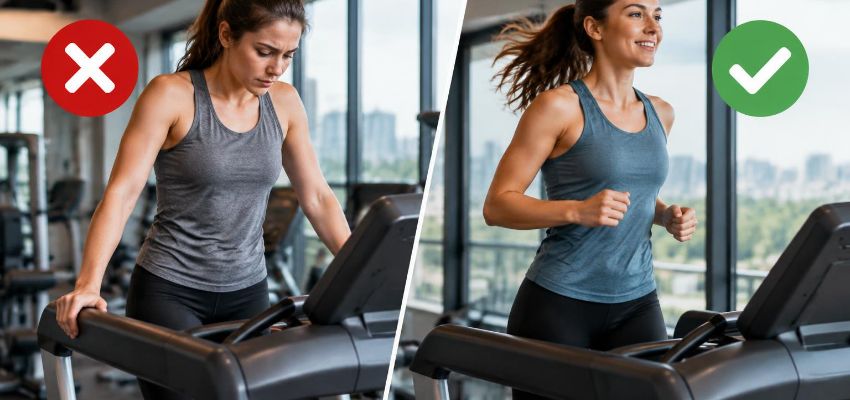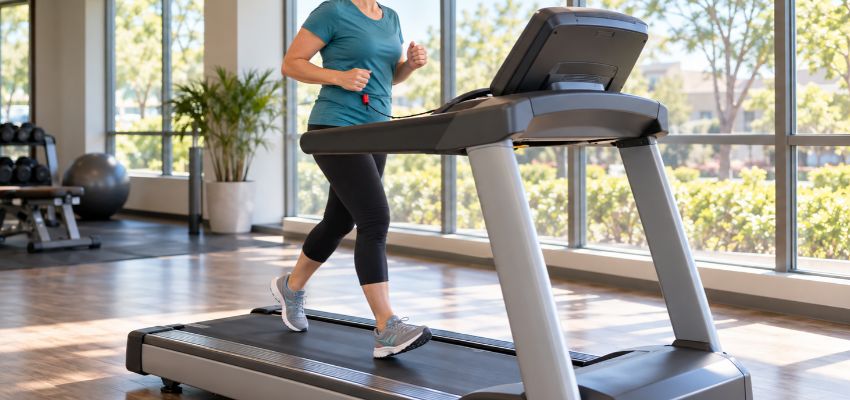
Zero percent can be enough when you are learning to jog, building a walk–jog routine, or keeping a session easy. You do not have to add 1% before your run counts.
You have found a speed you can manage, then someone tells you the treadmill should always be set to 1%. Before pressing the incline button, ask what you need from today’s session. Getting used to the belt and finishing short, controlled jogging intervals may already give you plenty to work on.
This guide focuses on beginner running on a conventional motorized treadmill. Incline walking is a different choice, and its popular workout settings are not starting requirements for a new runner.
- Incline percentage
The rise relative to horizontal distance. A 1% grade rises 1 unit for every 100 horizontal units; it does not mean a 1-degree angle.
- 0% incline
The treadmill’s nominal level setting, with no uphill grade selected. Actual deck alignment depends on the machine and its installation.
- Incline level
A machine or program setting that may not equal a percentage. Check the manual before treating “level 3” as 3%.
Speed controls how quickly the belt moves; incline changes its slope. Neither number alone tells you how hard you are working. The same flat setting can feel gentle during a slow walk and demanding during a jog.
The distinction between manual and motorized treadmills concerns how the belt moves, not whether incline adjustment is powered.
A motorized treadmill can still have a manually adjusted deck. Follow its instructions: a deck that requires manual adjustment must be stopped and adjusted as directed, not lifted while you are moving on it.
When Is 0% Enough for a Beginner?
When You Are Still Learning to Control Your Jog
Learning to use the console while moving, finding room on the belt, and settling into a controllable jogging speed are already separate skills.
Leaving the incline at 0% gives you one less setting to manage. You can notice what a speed change does without also wondering what the hill contributed.
Start with familiar controls and a manageable walk before jogging. Good treadmill setup includes knowing the stop controls and attaching the safety clip as the manufacturer directs.
Do that before experimenting with the slope; a new setting should not become your first lesson in stopping the machine.
When Your Walk – Jog Intervals Already Feel Demanding
Suppose you alternate a brief jog with walking and need each walk to get your breathing back under control. Adding incline may make those jogging intervals harder without helping you practice them better. Keep the deck flat while you find an interval length and speed you can repeat.
- The next interval still needs your attention You are working on repeating the jog, not looking for a harder version yet.
- Your steps feel rushed Adjust the speed or return to walking before adding a slope.
- You need support to hold the setting Use support when needed, then reduce the demand rather than forcing the chosen number.
When the Goal Is an Easy, Repeatable Session
An easy day can stay easy even after your fitness improves. Feeling comfortable is not an instruction to raise the deck. You might be maintaining a routine, returning after a tiring day, or simply choosing a lighter session.
Breathing helps put the display in perspective. The CDC talk test distinguishes moderate effort, when conversation remains possible, from vigorous effort, when only a few words are possible before pausing for breath.
This is a general intensity check, not a medical test. If an intended easy jog leaves you gasping, reduce the demand even at 0%.
A level deck is not automatically a reason to replace your machine, either. With a treadmill under $500, the first question is whether the particular model is intended for your running use and fits its stated limits.
Lack of incline alone does not tell you whether it is suitable, and a low price alone does not establish that it is.
Do Beginners Need the 1% Incline Rule?
What the Original Research Compared
The often-cited 1996 study involved nine trained male runners who were accustomed to treadmills. They completed six-minute bouts at several speeds on the treadmill and on a level road. The researchers compared oxygen consumption to find an incline that approximated outdoor energy cost.
Their tested speeds were roughly 6.5–11.2 mph. At the two slowest speeds, road oxygen consumption did not differ significantly from either 0% or 1% treadmill running.
The overall conclusion favored 1% across the tested range. That is useful context, but it does not establish an ideal grade for beginner walking, slow jogging, or every treadmill session.
Why Outdoor Equivalence Is Not a Starting Requirement
A study of energy cost does not set a minimum incline for a worthwhile beginner session.
Matching one physiological measure under particular conditions is not the same as reproducing outdoor running in every respect. Choose a grade that serves your session rather than treating 1% as a correction you always owe the machine.
You can use 1% deliberately if you want a small uphill challenge and can manage it. You can also stay at zero while working on a comfortable jogging rhythm. Neither decision requires you to calculate an exact outdoor-equivalent pace.
What Changes When You Add Incline?
More Challenge at the Same Belt Speed
Incline gives you another way to change the session when you do not want the belt moving faster. But keeping the same mph does not keep the effort the same. The Life Fitness explanation also notes the increased muscular demand of inclined running, particularly in the calves.
- Uphill practice on a controlled surface
- More challenge without a faster belt
- More effort at the same displayed speed
- A possible need to shorten or slow the session
- Extra calf demand during uphill running
This does not make incline inherently better than flat running. A hill has a purpose when uphill movement is what you want to practice. For an easy walk–jog session, the extra demand may work against the reason you came to the treadmill.
Why Walking Inclines Are Not Beginner Running Targets
The 12-3-30 routine means walking at 12% incline and 3 mph for 30 minutes. It is not a recommendation to begin jogging at 12%. Cleveland Clinic describes the routine as challenging and advises adjusting the workout to the individual rather than starting with the full prescription.
Imagine two people using adjacent machines. One chooses an uphill walk as the main workout. The other is practicing short jogging intervals at 0%.
Their incline numbers differ because their sessions differ. The second person does not need to copy the first person’s hill to make progress with running.
How Should You Try a Higher Incline?
Choose a Reason Before Raising the Deck
A useful reason might be wanting a brief introduction to uphill walking or jogging after flat sessions have become manageable. “Everyone else uses incline” is less useful: it does not tell you what you are trying to learn or how much extra effort to accept.
You do not have to progress speed, duration, and incline together. Choose what you want to work on. When the purpose is still learning to run comfortably, keeping the familiar grade while practicing that skill may be the better choice.
Make One Small Change and Recheck Your Effort
-
Establish your flat baseline
Begin with a comfortable warm-up walk, then settle into the walking or jogging effort you intended. Notice how your breathing and steps feel before changing the grade.
-
Check how the machine adjusts
On a powered incline, slow to a manageable walk before using unfamiliar controls. For manual deck adjustment, stop and follow the manufacturer’s procedure. If the first available grade is a large jump, skip the trial rather than assuming the lowest option must be gentle.
-
Try a small available increase
Keep the speed familiar if it remains comfortable; do not also extend the session. There is no universal percentage every beginner must reach.
-
Decide whether the change fits
Notice whether you can maintain controlled steps and the intended breathing effort. Reduce speed or return to your earlier grade when the change is too demanding. You do not need to finish a preset interval to justify stopping the experiment.
-
Review before adding more next time
Record the grade, speed, approximate time, and how the session felt afterward and the next day. Repeat a manageable version before considering another change; pain is not a progression target.
For example, imagine that your flat jog feels controlled, but the first small incline makes your breathing much harder. Returning to 0% lets you finish the easy session you planned.
Choosing a slower uphill walk would be another task, not a failed attempt to maintain your jogging speed. These are possible decisions, not a prescribed workout.
Know When to Return to 0% or Stop
Repeatedly holding the handrails just to maintain the speed or slope is a reason to reconsider the setting.
If you feel unsteady, use the rails for support while slowing or stopping; do not let go simply to prove the incline is manageable. Step off only after the belt stops.
A display showing an unexpectedly high heart rate is another reason to ease off and assess how you feel instead of defending the setting. Do not assume the number is a sensor error, and do not wait for a reassuring number if you feel unwell.
Stop for dizziness, feeling faint, pain that changes your movement, or unusual shortness of breath. Seek medical advice for new or recurring symptoms. Chest pain or pressure, fainting, or severe breathing difficulty needs urgent help. Call 911 in the U.S. if you suspect a heart attack; the AHA warning signs explain when to act immediately.
Before your next session, choose its purpose: a controlled walk–jog, an easy run, or deliberate uphill practice. Let that choice determine whether the incline button needs a role. If 0% lets you practice the movement and effort you intended, you can finish there. Add a slope when it serves a clear purpose, with room to lower it again.