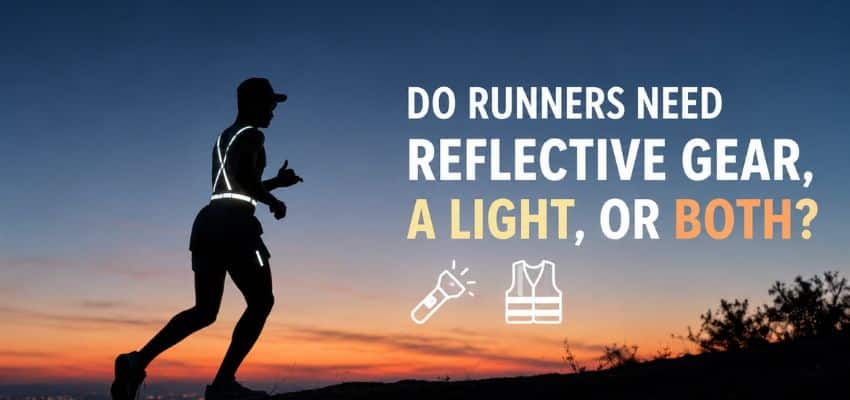
Do runners need reflective gear, a light, or both? Near traffic after dark, both are usually the most useful answer because they solve different visibility problems.
Reflective material helps drivers and cyclists notice a moving runner when their lights reach it. A wearable light produces its own visible point, while a forward-facing beam can reveal a cracked sidewalk, a puddle, or the edge of an unlit path. One helps other people see the runner; the other may also help the runner see the route.
The right choice depends on the darkest and busiest part of the route, not the brightness at the front door. A streetlit sidewalk may mainly call for conspicuity, while an unlit trail needs illumination underfoot. Rain, fog, parked cars, junctions, and a finish after sunset strengthen the case for combining reflective running clothing with a light. Neither guarantees safety, so a basic running gear setup that suits the route still includes route choice, awareness, and predictable movement around traffic.
Reflective gear, a light, or both?
- Reflective gear may be enough On a smooth, consistently streetlit sidewalk with little traffic, well-placed reflective details may cover the main need: helping other road users notice the runner. A small active light still adds another visible point at crossings and driveways.
- A light becomes necessary When the ground disappears between lamps, a forward-facing light is needed to reveal curbs, roots, puddles, gravel, and other hazards. Reflection cannot illuminate the next step.
- Both are the safer default near traffic On roads, at frequent junctions, in rain or fog, or on routes that mix lit and unlit sections, reflection and a light cover different weaknesses. Neither proves that a driver has noticed the runner.
For practical running visibility at night, plan for the darkest section and the most difficult traffic encounter rather than the easiest part of the route.
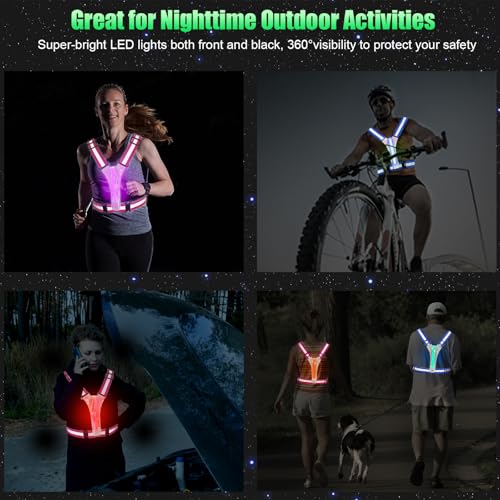
Being noticed is not the same as seeing the way
Conspicuity
How readily a driver, cyclist, or another path user notices and recognizes a runner. Reflective details and active lights can improve conspicuity, especially when they show movement.
Route illumination
Light directed at the surface ahead so the runner can see curbs, roots, potholes, wet leaves, and changes at the edge of a path. Reflective trim does not perform this job.
Fluorescent or bright clothing
Colors designed to stand out in daylight and poor daytime light. They can help at dawn or dusk, but they do not return headlight beams the way retroreflective material does.
Retroreflective material
Material that returns incoming light toward its source. It works best when a vehicle or bicycle light reaches it and is less useful when no light is aimed at the runner.
Active light
A powered light that produces its own illumination. Some lights mainly help others notice the runner; others direct a beam ahead to reveal the route.
Where reflective running clothing helps – and where it stops
Moving reflectors are easier to recognize
Reflective panels on the ankles, calves, wrists, or arms move in a pattern that can help a driver recognize a person rather than an unexplained bright speck. The NHTSA summary of pedestrian conspicuity research notes that retroreflective material on moving extremities can substantially improve nighttime recognition. It also makes an important distinction: better conspicuity has not been shown to eliminate crash risk.
Bright does not mean reflective
Neon yellow, orange, and pink can create useful contrast in daylight, cloudy weather, dawn, and dusk. After dark, however, a vivid shirt may become another muted shape unless it includes reflective material or is paired with an active light. Color and reflection are complementary features, not interchangeable labels.
Reflection has angles, gaps, and blind spots
A reflective strip cannot return light that never reaches it. Parked vehicles, a bend, an approaching car without a direct beam, dirty or poorly aimed headlights, and the runner’s position at a junction can all delay recognition. Rain, fog, spray, and wet-road glare reduce contrast further. Reflection improves the opportunity to be noticed; it does not create a promise that someone has seen the runner in time.
Bright clothing helps in available light. Reflective material responds to another light. An active light produces its own visible signal or illuminates the route. One item may perform more than one job, but do not assume that it does.

When a running light becomes necessary
A small visibility light can help before headlights arrive
On a streetlit route, a compact front or body light can make a runner easier to distinguish at driveways and crossings before a vehicle’s headlights point directly at reflective material. A rear-facing light can add presence for traffic or cyclists approaching from behind. The setup should remain visible from the directions that matter without dazzling other people.
A forward beam is for the runner’s next few steps
On an unlit or uneven route, a light aimed several steps ahead becomes the practical baseline. It should reveal the surface early enough to adjust pace and foot placement without forcing the runner to stare at one tiny bright circle. Roots, potholes, broken pavement, wet leaves, ice, and path edges are route hazards; reflective trim cannot reveal them.
Beam shape, stability, and charge matter as much as brightness
A very bright beam that bounces, points into approaching faces, or runs out of power before the final mile solves little. Test the angle while walking and jogging, confirm that the strap stays put, and check the expected runtime against the whole outing. Brightness, beam spread, fit, and battery life are the practical variables when choosing a running light for night running.
Choose night running safety gear by the hardest part of the route
-
Consistently lit, quiet sidewalk
Smooth pavement and steady streetlighting reduce the need for a strong forward beam, but driveways, side streets, cyclists, and patches of shadow still create moments when a runner needs to register quickly.
Useful setupReflective details placed where movement is visible, plus a small active light when crossings or traffic justify it.Do not assumeTreating streetlights as proof that every road user can see the runner. -
Crossing-heavy urban route
Turning drivers may be scanning for vehicles while rain, parked cars, signs, and shop lights compete for attention. Visibility needs to work from more than one angle.
Useful setupReflective elements plus a visible front or body light; add a route-illuminating beam if paving is broken or the run finishes later than planned.Do not assumeRelying on one reflective logo hidden by a jacket, arm position, or backpack. -
Dim road or shoulder
Vehicle headlights may be the main light source, and traffic speed leaves less room for late recognition. Surface edges can also disappear outside the beam of a streetlamp.
Useful setupBoth reflective material and an active light, with enough forward illumination to read the shoulder and enough visibility from approaching directions.Do not assumeAssuming a fluorescent shirt remains conspicuous after daylight has gone. -
Unlit park, canal path, or trail
Traffic may be limited, but roots, puddles, gravel, cyclists, dog walkers, and dark entrances remain. The runner’s need to see becomes as important as being seen.
Useful setupA stable forward beam as the baseline, with reflective details or a secondary visibility light for other path users and road crossings.Do not assumeChoosing passive reflection when there may be no light source nearby to activate it. -
Dusk, fog, or rain
Low contrast can arrive before official sunset. Spray and glare make both distance and movement harder to judge, while a familiar route may look different under wet reflections.
Useful setupCarry the setup the route will need later, even if the run begins in usable daylight.Do not assumeUsing the clock as the only switch for visibility gear.

Use visibility gear well without trusting it too much
Make the runner visible from more than one direction
A single reflective mark on the chest may disappear when the runner turns, bends an arm, or covers it with another layer. Check the complete outfit from the front, side, and rear with every jacket, belt, and pack in place. Moving reflective details on more than one limb can help communicate direction and motion, while an active light adds a visible point before headlight-dependent reflection appears.
Avoid dazzling the people who need to read the route too
A forward beam should illuminate the surface, not point straight into drivers’, cyclists’, or pedestrians’ eyes. A flashing mode may attract attention, but a steady forward beam is usually easier for the runner to use on dark ground. If one light is expected to serve both purposes, test whether its angle still leaves the runner visible without turning every approaching face into an unwilling product demonstration.
Keep traffic habits separate from equipment confidence
Pause before crossings, avoid stepping out from between parked cars, and use a predictable position on the route. Face traffic where local rules and the available route make that appropriate, but follow local pedestrian laws rather than assuming one rule applies everywhere. Even excellent running visibility at night cannot correct for a distracted driver, a hidden junction, or a decision made too late.
Reflective gear and lights improve the odds of being noticed; they do not prove that an approaching driver or cyclist has recognized the runner or will yield. At crossings, a deliberate pause still matters.
A 30-second visibility check before the run
-
Check the whole time window
Look at sunset, weather, and the likely finish time—not only the conditions at departure. Carry the gear needed for the darkest part of the outing.
-
Picture every lighting gap
Identify parks, bridges, tree cover, stretches between lamps, and detours where the surface may disappear. If the next few steps will not be readable, bring a forward light.
-
Count traffic encounters
Crossings, driveways, bike lanes, shoulders, and roads with turning traffic strengthen the case for reflective material plus an active visible light.
-
Check every viewing angle
Put on the complete outfit and make sure reflective areas or lights are not covered by a jacket, arm, backpack, or belt. Include front, side, and rear visibility where the route requires it.
-
Test the light in motion
Confirm the beam angle, strap stability, controls, and remaining charge while walking and jogging. A light that slips, dazzles, or dies early is not ready for the route.
-
Choose the simpler safe alternative when needed
If the setup cannot make the route reasonably visible, change the timing, shorten the run, or choose a better-lit route. More night running safety gear does not make every road or trail a sensible choice.
The check is finished when the runner can answer two questions separately: How will other people notice me, and how will I see the next few steps?

- Reflective material helps other road users notice motion when their light reaches it.
- An active light can add conspicuity and, when aimed ahead, reveal the running surface.
- Routes with traffic, poor weather, mixed lighting, or uneven ground often call for both.
So, do runners need reflective gear? When a route meets traffic after dark, reflective material is a useful visibility layer, but it should not be asked to illuminate the ground or overcome every blind spot. Add a light when the runner needs an active signal, a beam for the surface ahead, or both. Choose the setup for the darkest, busiest, and least predictable stretch of the run—and change the route or timing when equipment still cannot create a reasonable margin.