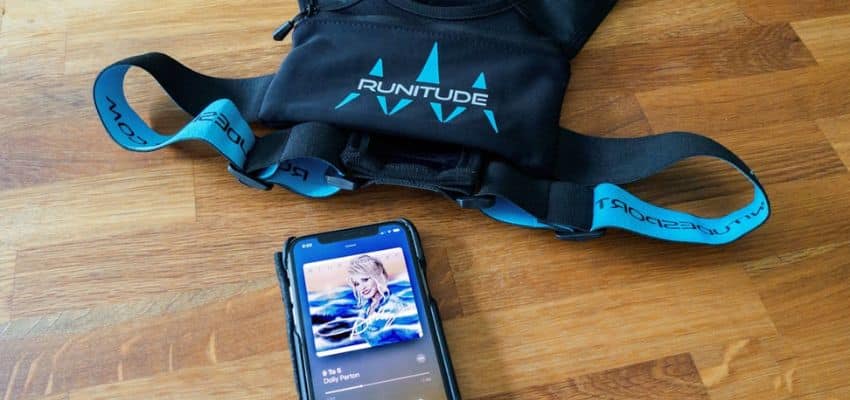
When a running belt keeps bouncing, the useful clue is not how annoying it feels but which part moves first.
A belt can feel secure at the door and begin hopping, climbing, or twisting within the first few minutes. Running turns a still fit into a moving system: the torso expands with breathing, the hips rotate, clothing slides, and every phone, key, gel, or flask gains momentum with each stride. A small mismatch that is invisible while standing can become obvious at pace.
The fix is rarely “tighten everything until breathing becomes optional.” First identify whether the belt is lifting vertically, riding toward a narrower part of the torso, rotating under an uneven load, or losing grip on the clothing beneath it. Then change one variable and repeat the same short run test. That is how a frustrating guess becomes a repeatable correction.
- Keep the usual load in the belt while diagnosing it.
- Name the direction of movement before changing the tension.
- Change position, tension, clothing, or load one at a time.
The fastest route to a stable running belt fit is to separate four problems that runners often call “bounce.” A belt that rises, falls, twists, or lets the phone thump against the body needs a different first adjustment.
Give the problem the right name
- Vertical bounce
The belt or loaded pocket repeatedly lifts away from the body and lands again. Look first at working tension, empty space around the load, and the mass of the heaviest item.
- Ride-up
The whole belt migrates toward a narrower part of the torso. Check starting height, clothing folds, band width, and whether tightening is turning the belt into a climbing edge.
- Downward slip
The belt gradually loses its place and sags. Check whether it sits on a sloping area, whether sweat or slick fabric reduces grip, and whether the strap is too loose or worn.
- Rotation
The pouch moves from the front or back toward one hip. Check weight distribution, twisted webbing, and whether the heaviest object is pulling from one side.
- Internal thump
The band stays in place but an object moves inside its pocket. Reduce unused pocket space, lay the object flat, and separate hard items that strike each other.
Use that map during a 30-second jog with the belt packed as usual. The first visible movement matters more than the final mess. If the phone starts thumping before the waistband shifts, for example, tightening the waistband may punish the runner without calming the phone.
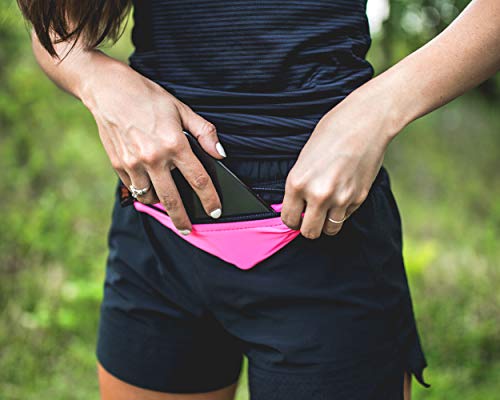
Read the direction before changing the fit
Recreate the problem on a familiar, level stretch. Walk for a few steps, jog easily, then spend 20 seconds at the pace where the trouble usually begins. Do not readjust mid-test. A clean observation is more useful than three nervous tugs made before the belt has shown what it wants to do.
If the belt lifts and lands with every stride
Vertical bounce means the loaded portion can move independently from the torso. Slide two fingers beneath the band and lift gently. If the whole belt leaves the body easily, take up a small amount of slack and test again. If the band remains close but the phone still knocks, the load has room to move inside the pocket; flatten it against the body or reduce the unused space before tightening further.
Watch the edge of the belt while jogging in place. If the band stays level but the pouch bulges and collapses, the problem is inside the pocket. If the entire edge rises and falls, tension, position, or total load is more likely.
Treating internal thump as waistband bounce often leads to needless over-tightening – and an impressive red stripe that solves absolutely nothing.
If the belt rides up or slips down
To stop a running belt riding up, begin with geometry rather than force. A belt placed below a narrowing waist may climb until it reaches the smaller circumference above it. Test the natural waist and the firm area just above the hip bones as separate starting positions. Keep the band flat, smooth the shirt or waistband beneath it, and jog at the same pace from both locations. A level belt over descending tights separates belt bounce from why running leggings fall down, a waistband-fit problem with its own causes.
Downward slip asks for the opposite investigation. Reset the belt at the position that felt most stable, remove only enough slack to prevent easy hand movement, and check for slick fabric or sweat. A belt can slide over a loose rain layer or glossy tights even when its size is correct. If it stays put over one outfit but not another, the contact layer – not the buckle – has supplied the answer.
If the pouch rotates or one side sags
Rotation usually follows weight. A large phone on one hip and keys beside it can pull the pouch around the torso like a slow pendulum. Center the densest item at the front or back, lay it flat, and move smaller pieces to the opposite side. Straighten twisted webbing from end to end; a flat strap spreads force, while a rolled edge behaves like a narrow cord.
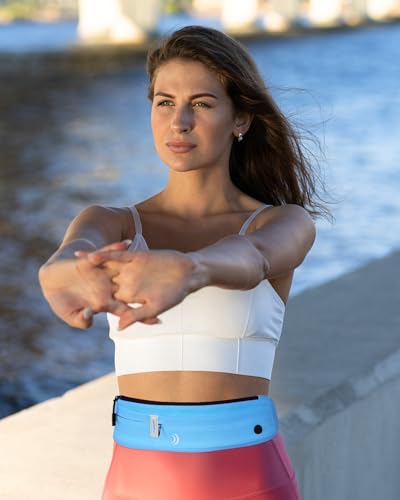
Build a running belt fit that survives movement
A useful fit does not mean the belt can never be moved by hand. It means the band follows the torso without lifting independently, pinching a full breath, folding at an edge, or requiring a fresh adjustment every few minutes.
Compare two heights instead of chasing one perfect spot
Place the packed belt at the natural waist for one short test, then just above the hip bones for another. Use the same clothing, load, route, and pace. The higher position often works for a light flexible belt because the waist offers a clear resting point. The lower position may steady a heavier phone because the pelvis gives the load a broader base. Body shape decides which is calmer; a universal “correct height” does not.
More pressure is not always more control
Loose tension can cause vertical lift, but a belt may also bounce because the pocket is oversized, the load is off-centre, or the band sits on a tapering part of the torso.
Name the movement first, then alter only the variable that can cause it. Tightening is one test, not the entire diagnosis.
Excess pressure can roll the band, make it climb, restrict breathing, or concentrate rubbing at one edge.
Use firm contact that stops independent lift while allowing a full breath and relaxed movement. Stability without comfort is not a successful fit.
A hard climb, quick descent, or clothing adjustment can disturb a belt that is otherwise stable through an ordinary run.
Look for a repeated pattern across comparable runs before judging the size or design. One unusual tug is information, not a verdict.
Set working tension without turning the band into a clamp
Tighten in small increments and repeat the same 30-second jog after each change. The belt should resist an easy upward pull and remain flat during a full breath. Stop tightening if an edge digs in, the band rolls, breathing feels guarded, or the buckle begins to migrate. Those are signs that added pressure is creating a new failure rather than fixing the original one.
Check the layer between the belt and the body
Flatten shirt hems, drawcords, folded waistbands, jacket edges, and anything else trapped beneath the belt. A bunched hem can be carried upward one stride at a time. A smooth low-friction fabric can encourage downward slip, while a thick seam can tilt the band. Test the belt over the outfit normally worn, then repeat after enough movement to produce sweat; a dry one-minute fitting does not always predict mile three. Extra seams or fabric make the layers under running shorts part of the fit diagnosis before more tension is added to an already crowded waistband.

Make the load behave inside the belt
Once the band itself stays flat, turn attention to what it carries. Total weight matters, but placement and empty space matter too. Two small items separated across the body may feel calmer than the same items stacked on one hip.
Keep the heaviest item close and centred
Place the phone or flask against the body near the front or back centre, depending on the belt design. Keep the object flat rather than angled across a pocket. Separate keys from the phone so a hard point cannot strike the screen or skin. Then jog through a turn and a short gentle downhill, where side-to-side pull and vertical momentum usually appear sooner.
Reduce pocket space the load can cross
A roomy pocket is not automatically a stable one. When the belt remains still but the phone travels inside it, use the smallest compartment that holds the device flat or reduce the rest of the load. A large phone case, loosely folded tissue, and keys can turn one pocket into a tiny percussion section. Once an oversized device overwhelms the belt, how to carry a phone while running becomes the real storage decision; squeezing harder around the waist cannot make an unsuitable pocket smaller.
Test the complete load at the pace that exposes the fault
An empty belt can pass beautifully and fail as soon as a full flask returns. Add ordinary items one at a time and run for 30–60 seconds after each addition. Include a few turns, a short quicker section, and the actual clothing used on normal runs. The item that starts the movement reveals the belt’s practical capacity more clearly than a printed pocket volume.
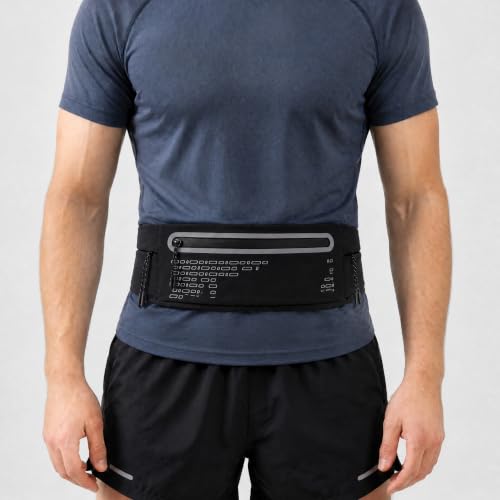
Run a five-minute belt reset
-
Recreate the usual setup
Wear the normal shorts, tights, or outer layer and pack the phone, keys, fuel, or flask normally carried. Diagnosing an artificially light belt produces an artificially tidy answer.
-
Choose one starting height
Set the band flat at the natural waist or just above the hip bones. Smooth every layer underneath and note the chosen position so it can be repeated.
-
Set working tension
Remove enough slack to stop easy lifting while preserving a full breath. Do not make another change before the movement test.
-
Walk, jog, then add pace
Move through the three stages without readjusting. Name the first fault: vertical bounce, ride-up, slip, rotation, or internal thump.
-
Change one cause and repeat
Alter only position, tension, clothing contact, or item placement. Keep the other conditions constant so a calmer result can be reproduced on the next run.
If the same ordinary load fails after two or three controlled tests, the result is evidence of a size, capacity, design, or wear problem—not an invitation to tighten forever.
Write down the one change that worked. A repeatable setup is more valuable than accidentally achieving silence once. It also prevents the next run from beginning with the familiar ritual of pulling, twisting, and blaming the belt before the first corner.

Know when adjustment has reached its limit
A belt that needs one small reset after a hard hill is not necessarily defective. The stronger signal is repetition: the same ride-up, slip, rotation, or bounce returns within a few minutes on ordinary runs despite a flat band, balanced load, and tested position.
Inspect elastic, closures, and pocket shape
Test the belt empty. Tired elastic may feel slack even after adjustment or relax quickly once stretched. A buckle that creeps, hook-and-loop that peels, a cord lock that slips, or a pocket that has become floppy can create instability off the run. No packing technique can restore hardware that no longer holds its setting.
Recognise a capacity or body-shape mismatch
A sound belt can still be wrong for the job. A belt that stays quiet with keys but bounces with the normal phone and flask lacks the pocket layout or band width to control that load. Repeated gathering at the waist or sliding over the hips in every available size also signals a shape mismatch. A broader beginner running gear guide should therefore treat the belt as useful only when it controls the runner’s actual load; otherwise, a simpler carrying method is the better fit.
Know what “no bounce” should mean before replacing it
A no bounce running belt should hold the runner’s real essentials close through the movements that matter, not promise absolute stillness in every body, outfit, speed, and load. Before replacing the current belt, define the failure the next design must prevent: a firmer pocket for a large phone, a wider band that resists rolling, separate storage for keys, or enough structure for hydration. For a race-day load limited to a phone and keys, a non-bouncing race belt should be judged under 5K conditions, not accepted on the strength of a general no-bounce claim.
When to stop readjusting the same belt
-
The same fault returns
The belt repeats the same bounce, ride-up, slip, or rotation in two or three controlled short runs.
Evidence of mismatch or wearFailure under comparable conditions after a careful resetA reason to keep testingJudging one rushed or unusually hard outing -
The setting cannot hold
Elastic relaxes, a buckle creeps, a closure opens, or the pocket collapses even when the belt is empty.
Evidence of mismatch or wearA mechanical problem visible before runningA reason to keep testingCompensating for worn parts with more pressure -
Ordinary essentials exceed control
A balanced normal load remains unstable although the empty belt fits securely.
Evidence of mismatch or wearA clear capacity or pocket-layout limitA reason to keep testingTesting with an unrealistically empty belt -
Comfort and stability cannot coexist
The belt stays still only when it pinches, rolls, restricts breathing, or creates concentrated rubbing.
Evidence of mismatch or wearA size, width, or torso-shape mismatchA reason to keep testingCalling painful compression a successful fit
Replacement is justified when the diagnosis points to a specific limit. Without that clue, a new belt can reproduce the same bounce in fresher fabric. The goal is not to buy a promise; it is to choose a design that controls the load and movement the current belt could not.
Running belt bounce questions
Why does my running belt keep bouncing even when it feels tight?
The band may be tight while the load still moves inside an oversized pocket, pulls from one side, or sits too far from the body. Check whether the whole belt lifts or only the phone or flask thumps. Reposition and flatten the load before adding more pressure.
How tight should a running belt fit?
A useful running belt fit holds the band flat and prevents easy independent lifting while allowing a full breath and relaxed movement. If the edge digs in, rolls, restricts breathing, or creates rubbing, it is too tight even if the bounce becomes quieter.
How do I stop a running belt riding up?
Test two starting heights: the natural waist and the firm area just above the hip bones. Keep the band flat, smooth clothing beneath it, and use only enough tension to prevent lifting. A belt often climbs because it begins below a narrower area or catches a shirt fold, not simply because it is loose.
Does putting a running belt on the front or back reduce bounce?
Either can work. The better position keeps the heaviest item centred, flat, and close to the body without interfering with arm swing or stride. Compare front and back with the same load and pace; side placement is more likely to create rotation when one item dominates the weight.
Do I need a new no bounce running belt?
Not until controlled tests show a repeatable limit. Replace the belt when worn hardware cannot hold, ordinary essentials exceed its capacity, or stability requires painful compression. Choose the next design to solve that identified fault rather than relying on a general no-bounce claim.
The calmest fix is usually small: a flatter band, a better starting height, one less item in the crowded pocket, or the phone moved back to the centre. When the correction is specific, it can be repeated instead of rediscovered halfway through every run.
Make the belt reveal the cause
- Name the movement before changing the fit.
- Test position, tension, clothing, and load one at a time.
- Replace the belt only when repeated tests expose a clear limit.
When a running belt keeps bouncing, the answer is not automatically a tighter strap or a new purchase. Watch whether the band lifts, climbs, slides, rotates, or merely lets an object move inside the pocket. Each direction narrows the likely cause.
Build a stable fit at the height that suits the runner’s body, use firm but breathable tension, smooth the clothing beneath it, and centre the real load. If the same failure returns across controlled tests, that persistence is useful evidence: the belt is worn, overloaded, or mismatched. Until then, change one thing, run the same test, and let movement – not marketing – make the decision.