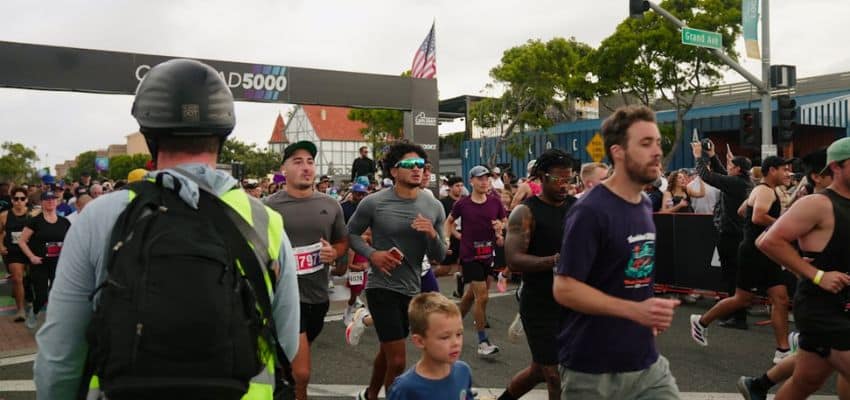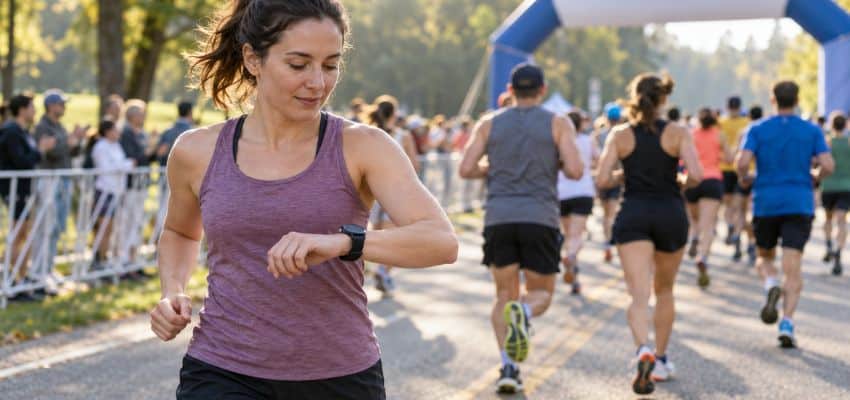
You want a walking break. There are footsteps right behind you.
That can be the awkward part of walking during a 5K: deciding how to slow down when other people are still running. You don’t need an elaborate maneuver. Look around, signal before changing speed, and use the available space without cutting across someone.
A walking break can be part of your plan from the beginning. At an event that welcomes your intended pace, you don’t have to wait until you’re exhausted to take one. The courtesy is in how you change speed and share the route.
Before entering, check the event’s walking policy and cutoff against a realistic estimate of your time. If you intend to walk the whole distance, say so when asking the organizer about suitability.
That belongs alongside the other practical decisions you make as you prepare for your first 5K.
Before you slow down, give nearby runners time to react
The change from running to walking is what someone approaching from behind needs to notice. Think about it before the exact moment you want to walk, especially if you’re using regular intervals. A little awareness now is more useful than an apology after someone has had to dodge you.
Look for people and space – not just the edge of the road
Look ahead for a bend, a narrowing path, or people bunching up. Check beside you and take a brief glance behind, keeping your own direction steady. You’re looking for anyone close enough to be affected by your slowdown, including someone already starting to pass.
Then look at the space you could use. It might be toward a side, but it should still be on the marked route and clear enough to enter. A strip of grass, a deep gutter, or a gap beyond course cones isn’t automatically a place you should step.
You can make the first change easier by joining the appropriate starting group. Take both jogging and walking into account, and follow assigned groups.
The rest of first 5K start etiquette concerns those opening minutes; once you’re on the route, keep reassessing the people around you.
Signal before the change, not after you have already slowed
Raise a hand where it can be seen, or give a short warning such as “Walking.” Do it before reducing speed. You don’t need to announce your entire interval plan to the neighborhood.
Keep looking, too. Someone may not hear a spoken warning, and a raised hand doesn’t tell you whether the space beside you is clear. The Jeff Galloway walk-break guidance pairs an advance hand signal with checking behind and moving toward a side where the course allows it.
If you’re following run–walk intervals that suit you, use the approaching break as a reminder to notice your surroundings. The beep is a cue to make a considerate change, not a command to slow at that exact patch of pavement.
Ease into a walk without cutting across someone
When space permits, move gradually toward a suitable side and ease down to a walk. Avoid a sharp diagonal move followed by a sudden slowdown. Those are two changes for nearby people to react to at once.
For example, if someone is coming past your shoulder, don’t shift into their path. If you’re comfortable maintaining your movement briefly, let them clear the space first. If you need to slow now, keep your direction predictable and use the approach below.
Once walking, continue forward rather than stopping to check the timer. If you need a complete stop, that calls for a place outside the moving stream of participants.
No room to move aside? You can still slow down
A narrow section may offer no convenient edge at all. Don’t turn “move aside” into a rule that forces you to keep running when you need to walk.
If you’re comfortable waiting briefly, look for a wider opening. If you need to slow immediately, signal and reduce speed as smoothly as you can while keeping your direction steady.
Move sideways only when there is space. Don’t squeeze between shoulders, cross into oncoming participants, or step beyond the marked course to get out of everyone’s way. A marshal can help if the route arrangement is unclear.
Wet conditions make the choice of footing important as well. Puddles, slippery edges, or uneven ground may make a proposed place to move over unsuitable.
That is one practical reason a rainy 5K needs a little extra preparation: know the conditions, and don’t trade reliable footing for a hurried sideways move.
If you feel faint or unable to continue safely, stop and ask for help. Alert a nearby participant or volunteer if you cannot move aside safely. You do not need to keep running to satisfy an etiquette rule.
An ordinary walking break and needing assistance are different situations. The first is about making a change others can anticipate; the second is about getting help. Don’t let concern about inconveniencing someone blur that distinction.
While walking, leave room without squeezing yourself off the course
After slowing down, settle into a steady direction with a usable gap for others where the route allows. You don’t have to press yourself against a curb. Several familiar-sounding rules need a little context:
Follow the event’s directions and course flow. Use an appropriate side when space allows; don’t cut across people to reach the right.
The route may be too narrow even for two. Leave a passing gap and switch to single file when space tightens.
Avoid a sudden sideways move. Keep your direction predictable and make more room only when it is safe.
If someone calls “On your left,” don’t reflexively step left into their intended path. Keep aware of where they are and what space is available. Similarly, look before stepping around a pothole, cone, or another walker; a small movement toward the middle may cross someone’s passing line.
Good passing on a crowded course requires care from the person overtaking as well. You can leave room without treating every approaching runner as an emergency. Stay aware, and let a normal pass remain normal.
Walking with friends works better when the group can change shape
Walking beside a friend can be one of the pleasant parts of a community 5K. It only becomes a problem when the conversation spreads across all the available space. The group needs to fit the route, rather than expect everyone else to fit around it.
- Leave a passing gap Side by side works only when the route still has room for others.
- Use single file in tight spots Narrow the group before a pinch point or when people need to pass.
- Wait away from the moving crowd If someone falls behind, find a suitable place to regroup without blocking the route.
Imagine three friends chatting as a wide road feeds into a narrower park path. Instead of reaching the entrance shoulder to shoulder, they can settle into single file before the pinch point. Nobody needs to abandon the conversation; they just need less width for a while.
Make any change with awareness of the people behind you. A group shouldn’t all stop together or fan sideways at once. If you’re walking while a friend wants to jog ahead, agree to meet later. Neither person has to change their whole outing to keep the group physically attached.
When you’re ready to jog, check the space again
The runners beside you may be different from those you saw when you started walking. Take a fresh look rather than assuming the gap you used earlier is still open.
Start gently along the line you are already following
Check ahead so you aren’t accelerating toward another walker. Check beside and behind for someone passing. Then, when there is room, ease into a jog along your existing line.
There’s no requirement to rejoin the middle. If your current position is suitable and follows event directions, you can keep jogging there. Change position only when it helps you continue and the space is clear. Running again doesn’t give you priority over someone already moving through the gap.
If you aren’t ready, keep walking. A timer can suggest the next interval, but you can adjust to how you feel and what the course allows. You do not owe the watch an immediate restart.
Let repeated passing stay ordinary
With run–walk intervals, you may pass someone while jogging and be passed by them during your next walk. That can happen several times. There is no need to explain yourself, compete with them, or sprint away to avoid meeting again.
Keep the same courtesy on each pass and leave space before moving across. Resist speeding up to compensate for walking. The reasoning behind starting your first 5K without a rush still matters after a break: someone else’s movement doesn’t need to set your effort.
Water stations and the finish are places to keep moving through
These are places where many people change speed at once. Look beyond the person immediately in front, and follow volunteers rather than assuming the crowd will move in one consistent way.
At a water station, leave the pickup area usable. If your event has one and you want a drink, approach the tables without cutting across people. Take the cup and continue past the volunteers. If you want to stop to drink, find clear space farther along instead of standing beside the table or blocking the next person’s reach.
Watch for people leaving the station as well as entering it. Someone may turn back toward the route while looking down at a cup. Slow or wait if necessary rather than trying to squeeze through the last sliver of space. Use the provided disposal areas without throwing a cup toward other participants.
At the finish, walking across is fine. Follow the marked chute and continue toward the finishers’ area. Keep going beyond the line before stopping for your watch, a photo, or a friend.
Knowing what happens after the finish line helps you find the proper place to pause.
If you need to stand still, look for a place where people don’t need to reach a table, cross a timing line, or move through a narrow exit. Being at the side is only helpful if that side is actually clear.
A walking break can be part of a good 5K
You can learn how to walk during a 5K without blocking runners while keeping the outing comfortable for yourself. Give nearby people notice, use the space available, and take another look before changing speed again. A crowded route won’t always offer a perfect gap; it doesn’t require a perfect performance from you either.
Before the event, try a few relaxed running-to-walking transitions on a familiar route where it’s safe to practice. The simple habit of looking before you change direction can feel much less awkward with repetition.
Whether you eventually switch from run–walk to continuous running is a separate choice. For this 5K, you can leave with a good experience that included walking – and a reason to keep enjoying movement afterward.