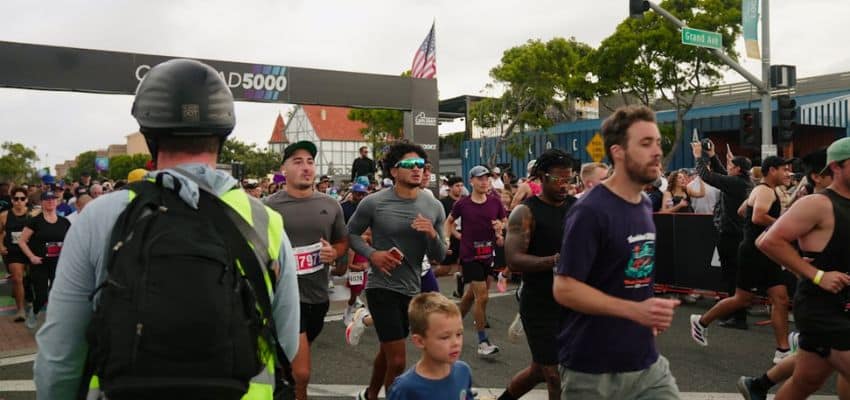
The hardest pace to ignore may be the one everyone else chooses for you.
The start signal goes, the people beside you move quickly, and your feet follow before you have made any real decision. For a few moments, the faster rhythm may even feel surprisingly comfortable. Your legs are fresh, the crowd is carrying you forward, and slowing down can feel almost rude – as though you are already falling behind.
That is why your first 5K should start slower than the opening rush tempts you to run. “Slower” does not mean choosing an awkward shuffle or giving up on the day before it begins. It means leaving enough room to discover how the effort actually feels once the noise settles. A calm start cannot promise a faster finish, but it can stop strangers’ footsteps from making the first important decision of your race.
Why the first few minutes can fool you
A first 5K rarely begins in the same quiet way as an ordinary run. Fresh legs can hide the cost of the pace for a little while, while the movement around you makes that pace feel normal. Those two influences are worth separating before deciding how hard the opening should feel.
Fresh legs can make the wrong pace feel right
The first steps do not ask much of you yet. Your legs have not had time to become tired, and a pace that would feel demanding later may still feel harmless now. That short delay can be misleading. It is easy to treat an easy-feeling first minute as proof that you have found unexpected speed on race day.
I would be cautious with that feeling. The opening pace can behave like a small loan whose first payment is not due yet. You get the excitement immediately, while the heavier breathing and harder work may arrive several minutes later.
By then, holding the same speed may require far more attention than it did just beyond the start line.
This does not mean every lively first step is a mistake. It simply means the beginning gives you too little information to know what the whole 5K will feel like. Waiting a little before asking for more effort leaves you with choices later.
The crowd can choose before you notice
A busy start creates its own rhythm. You see the back of one runner, match that person for a few steps, then match the next. Nobody tells you to speed up. The moving crowd does it quietly, especially when being passed feels like evidence that you are doing something wrong.
But the person beside you may have run many races, may be aiming for a very different finish time, or may be making exactly the same mistake you are trying to avoid. Their pace tells you almost nothing about the pace that will feel manageable in your body today.
Where you stand can also affect how much of that early rush reaches you. Understanding first-race start-line etiquette can make it easier to begin among runners and walkers moving at a similar effort.
Once the race starts, however, you are still allowed to let a gap open. You do not owe the people around you matching footsteps.
What starting slower actually means
“Start slower” can sound useless when nobody explains what the comparison is. I am not comparing one runner with another or asking every beginner to follow the same pace. I am comparing a deliberate start with the faster effort that excitement may choose before you have checked how it feels.
Slower than the rush, not slower than everyone
There is no single slow pace that fits every first-time runner. One person may run the entire distance. Another may use planned walk breaks. Someone else may simply hope to reach the finish without turning the day into a miserable test. A starting pace cannot be judged without knowing the person running it.
For me, starting slower means beginning below the effort that race-day excitement is trying to pull from me. I want the first few minutes to feel controlled enough that I can notice the course, my breathing, and the way my legs are moving.
A realistic beginner running pace comes from an effort you recognize, not from the speed of strangers disappearing up the road.
This may look different from what you imagined a race should look like. People may pass. The pace shown on your watch may be slower than the number you hoped to see.
Neither one proves that the start is going badly. The useful question is whether you still feel able to settle rather than already having to defend the pace.

Let breathing confirm what the start concealed
Once the pack spreads out, breathing offers a simple way to check what the opening excitement may have hidden. The CDC’s talk test describes moderate-intensity activity as effort during which a person can talk but not sing; during vigorous activity, saying more than a few words may require a pause for breath.
A 5K does not require you to stay at conversational effort from start to finish, so I would not turn the talk test into a rule. I would use it as a rough early clue.
If I intended to begin calmly but could barely get out a few words once the start-line bustle had passed, I would know the effort was already higher than I meant it to be.
The pace estimate entered at registration may help organizers place runners, but it is not a promise you must defend after the race begins. Weather, nerves, sleep, hills, and the simple strangeness of a first event can all change how the same number feels.
A controlled beginning leaves room to respond. You may keep the same effort, ease off, or decide later that a little more feels reasonable. The point is to make that choice yourself instead of borrowing it from the crowd.
A calmer way through the opening minutes
You do not need a detailed pace chart to make the opening calmer. A few small decisions can create enough space to notice your own effort before the race becomes difficult. None of them asks you to stand still while everyone leaves; they simply stop the first rush from becoming your plan for the whole distance.
Five ways to keep the opening under control
-
Let the first rush pass
Move with the space around you, but do not chase the quickest feet nearby. A few seconds near the start are not something you have to win back.
-
Leave room around your effort
If you are running close behind someone, check whether you chose that rhythm or simply fell into it. Letting a small gap open can make your own pace easier to notice.
-
Wait before judging the day
Fresh legs and excitement can make the opening feel unusually easy. Give the effort time to reveal itself before deciding you can run harder than usual.
-
Find something familiar
Look for a breathing pattern and stride that resemble an ordinary run. Familiar does not mean effortless; it means you are not fighting the pace from the beginning.
-
Keep the right to change your mind
The first pace is not a contract. You can slow down, walk, or add effort later when you have better information about how the day feels.
Conditions can change what familiar effort feels like. Rain, humidity, wind, and slippery ground may all make patience more useful at the start.
Let the day change the plan
Conditions deserve their own vote in that decision. A wet first 5K start may change footing, visibility, comfort, and the effort that normally feels easy. Starting from today’s conditions is more useful than trying to reproduce a number from a dry practice run.
A first 5K is not reserved for people who began running young. Someone starting to run after 40 may bring a different pace and a different history to the line, but neither needs an apology. Beginning calmly is not a public announcement about fitness. It is simply a way to run the event you came to run.
Signs the start was faster than you intended
A quick opening does not always announce itself with one dramatic warning. More often, it shows up as a pattern: you are spending too much attention maintaining the pace, and the effort keeps climbing instead of becoming steadier. Those two signs are more useful than one bad-looking number on a watch.
You are working to protect the pace
One clue is the feeling that you must keep proving the opening speed was correct. A runner passes, so you speed up. The watch shows a slower number, so you push. The person you followed begins pulling away, and instead of letting them go, you work harder to keep their back in sight.
The pace may be choosing for you
None of these signs proves exactly what is happening inside your body. Together, they are reasonable reasons to reassess the effort.
The effort keeps rising instead of settling
The start of a race can be noisy and awkward without being too fast. Nerves may make the first breaths feel strange, and weaving through people can briefly interrupt your rhythm. I would give that bustle a little time rather than judging the entire run in the first few steps.
What matters is the direction the effort takes. If breathing becomes steadier and the stride begins to feel familiar, you may simply have needed space.
If every minute asks for more work while you are still trying to hold the same pace, easing off is a reasonable response. You do not need a watch alert or a dramatic moment to give yourself permission.
What to do after a fast start
Realizing that the opening was too fast does not ruin the rest of the 5K. The useful response is not to punish yourself or calculate how to recover every second. First let go of the pace you did not mean to choose; then decide whether slower running or a walk break gives you the better next step.
Stop defending a pace you did not choose
When I realize I have started too quickly, my first temptation is to bargain with the pace: perhaps I can hold it a little longer, perhaps slowing now will waste the quick beginning, perhaps everyone will notice. None of those thoughts makes the remaining distance easier.
I would ease the effort before it turns into a larger argument. Let people pass. Allow the steps to become shorter if that feels natural. Stop checking how many seconds have been lost.
The pace you accidentally chose near the start does not deserve protection simply because you have already spent a few minutes running it.
There is no need to diagnose the exact mistake while moving. You can respond to what the run feels like now. If the effort settles, continue from there. If it does not, adjust again. A first 5K is still yours after an imperfect first kilometer.
A walk break does not erase the race
Walking can be the simplest way to bring the effort down. Before changing speed, glance around and move predictably so you can walk without blocking other runners. Then let the break do its job. It does not need to be followed by a burst of speed to repay the time.
You may walk briefly and begin running again when your breathing feels more controlled. You may need another break later. You may decide that alternating running and walking is the better way to finish the day. None of those choices cancels the distance already covered or the reason you came.
Adjusting early is not admitting defeat. It is responding to information you did not have when the crowd began moving.
Give the first 5K room to unfold
- Do not judge too soon Fresh legs and a moving crowd can make an ambitious opening feel easier than it will later.
- Run from your own signals Use breathing, effort, and familiar rhythm instead of treating another runner’s pace as instructions.
- Adjust without repayment Slow down or walk when the effort keeps rising. There is no need to chase back the time.
A calm start does not guarantee a faster finish. It gives you more opportunity to make deliberate choices as the race unfolds.
By the time the crowd spreads out, the runners who rushed ahead may already be out of sight. I do not need to know whether their pace was right or wrong. I only need to notice whether the pace under my own feet still belongs to me.
That is the real reason your first 5K should start slower: not because one cautious formula works for everyone, and not because holding back promises a faster finish. A calmer beginning gives the noise time to fade before you decide what effort the day can carry. If you start too fast anyway, you can ease off, walk, and continue without turning the rest of the distance into punishment.
Pace is only one part of preparing for your first 5K. Arriving with enough time, understanding the start area, and knowing what the event may feel like can also make the day less overwhelming. Perfect pacing is optional. Reaching the finish while still feeling that the run was yours is already worth something.