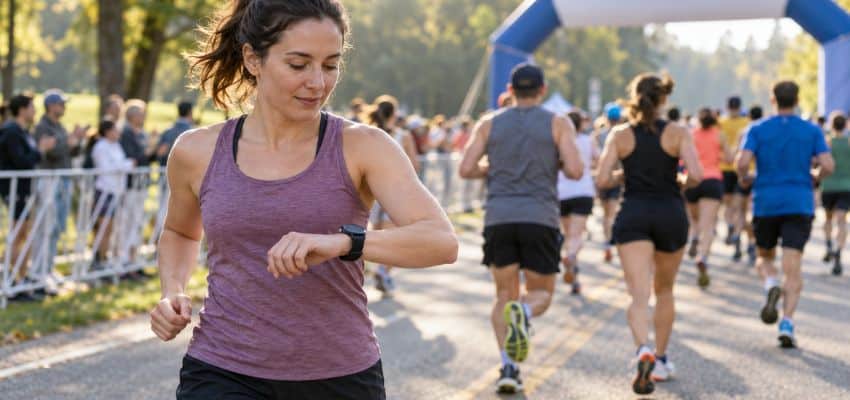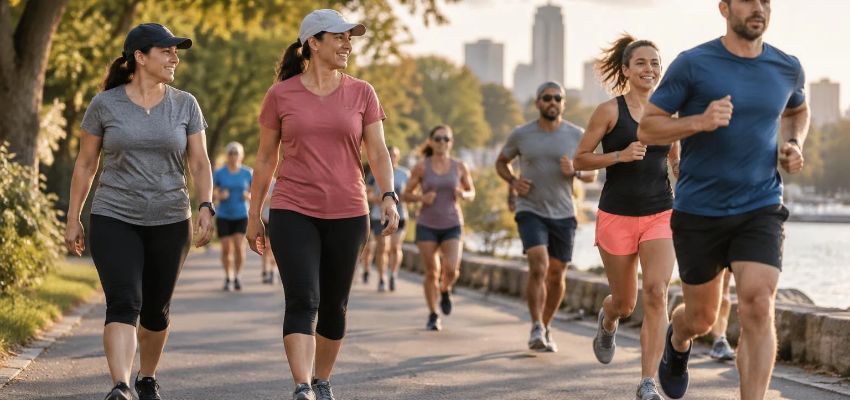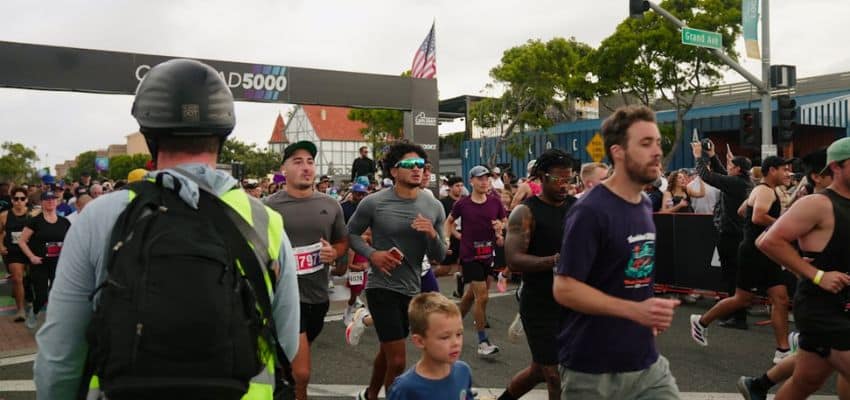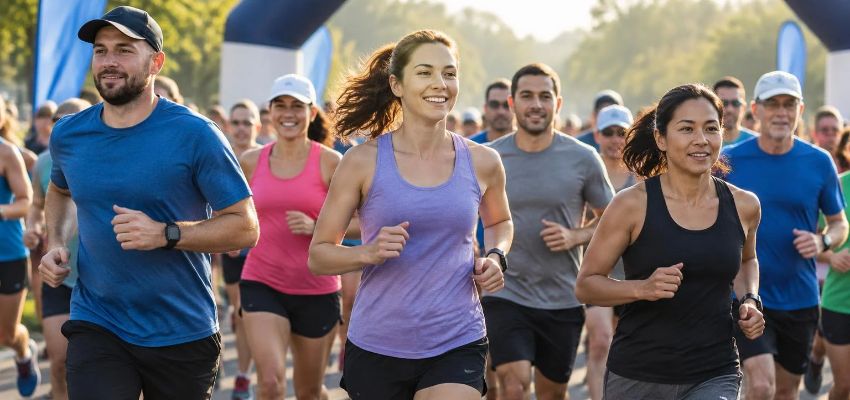
The horn sounds. You may still be walking.
At home, you start running when you’re ready. At your first organized 5K, there’s a countdown, people cheering, and a crowd beginning to move. It can feel as though you’re supposed to take off with them – even when the person ahead hasn’t taken a step.
You can walk with the crowd and begin jogging when there’s room. First 5K start etiquette comes down to leaving space, making your movements easy to follow, and following the event’s instructions. You don’t have to match anyone else’s speed to belong there.
This is the crowded few minutes around the start, one small part of how you prepare for your first 5K. The aim is to get through them comfortably, whether your plan is an easy jog, a run with walking breaks, or a walk at an event that welcomes walkers.
A suitable starting spot puts you near people likely to move at a similar speed. It gives everyone a little less weaving to do. Your job is to follow the arrangement the organizer has provided, rather than guess where an experienced runner would stand.
Follow your assigned group, and ask if the signs are unclear
Some events use corrals, marked holding areas, or waves, groups released at different times. Others simply have signs showing expected finish times or minutes per mile. Check your bib and the event’s instructions before joining a group; a letter on your bib may matter more than where a friend is waiting.
If you’re unsure, give a volunteer something useful to work with: “I’m planning an easy run with some walking. Where should I start?” That is clearer than asking where beginners go. People entering their first event have different abilities and plans.
Once you’re in place, keep listening. A horn may be sending an earlier wave on its way while yours stays put. Follow the release instructions for your group rather than edging forward because someone nearby does.
Choose by your plans for today, not by age or appearance
When there are pace signs, use a realistic estimate of how you expect to cover the distance, including planned walking. If there’s a designated walking group, follow the event’s directions for it. Without signs, ask a volunteer rather than assuming the very back is automatically the right place.
Choosing where to line up for your first race is about how the group will move, not how athletic anyone looks.
If you’ve wondered whether it’s too late to start running at 40, that question doesn’t decide your row either. Use your current ability and the event’s arrangement.
Coming with a friend? Agree beforehand whether you’ll stay together or meet afterward. If you have different assigned groups, respect those assignments. You can share the day without sharing every step.
Get comfortable before the countdown
Small adjustments are easier while you have somewhere to stand. Leaving enough time to find the start and sort yourself out matters more than squeezing in another photo. Work backward from the organizer’s check-in and group-closing times when deciding how early to arrive for a 5K.
Take care of these while you have space
-
Check your shoes and clothing
Tie loose laces and fix anything rubbing or slipping. Step aside from entrances so others can reach their groups.
-
Put loose items away
Secure your phone, keys, and anything you’re carrying. Keep your hands free of things you’ll need to juggle as you start.
-
Prepare your watch, if you use one
Open the activity screen before the crowd moves. You can also leave the watch at home; recording the outing is optional.
-
Finish photos and listen
Put the camera away when the group begins moving. Follow the headphone policy and keep announcements audible.
You don’t need to fill the wait with conversation or look as though you’ve done this before. Stand comfortably, leave space around you where possible, and listen for instructions. A volunteer is a better source of last-minute directions than the most confident voice in the queue.
When the horn sounds, move with the people ahead – even if that means walking
The front of the group may be running while your section is barely moving. That doesn’t mean you’ve missed your chance to start properly. There is simply a queue of people between you and open road.
Wait for enough room to take comfortable steps
Walk with the people immediately ahead. If they pause, pause too, leaving enough room that you aren’t stepping on their heels. Jogging in place or squeezing between shoulders won’t create more space.
As a gap opens, let your walk become a jog without a sudden burst forward. You may need to walk again if the crowd bunches up. That is a response to the available space, not a failure to run the event correctly.
Keep looking along the route rather than down at a screen. The person in front can change speed before your watch has anything useful to tell you.
Keep moving across the line; your watch can wait
You may still be walking when you cross the starting line. Continue with the flow. Don’t stop on the line or just beyond it to press a button, wait for a friend, or take a photo.
If the watch doesn’t start, leave it for a moment. Missing the opening seconds of a recording is easier to deal with than stopping directly in someone’s path. You can check it when you have room to do so without losing awareness of the people around you.
The Road Runners Club of America’s etiquette guidance specifically advises against stopping at the start or finish for photos or watch adjustments. The same habit of keeping the line clear will matter after you cross the finish line.
If timing worries you, check how this particular event records results beforehand. Don’t assume every 5K uses the same system—and don’t let uncertainty about a clock push you through a gap that isn’t there.
Let people pass without feeling you have to follow them
Someone running past may be aiming for a personal best. Someone else may have started in the wrong place. Neither situation changes what you came to do. Being passed is part of sharing the course, not an instruction to speed up.
Keep your direction steady. If you hear someone approaching, avoid jumping sideways without looking; that can put you into the space they intended to use. Allow room when you can, and follow any course-specific directions from marshals.
That works both ways. If you catch up with someone, wait for a clear route rather than threading between people. A brief delay is easier for everyone than a sudden sideways move.
Good passing on a crowded race course leaves the other person room to keep moving comfortably.
| When this happens | A comfortable response |
|---|---|
| People surge past you | Keep your direction and let them go. |
| The person ahead slows down | Leave room and wait if there is no clear way around. |
| The route narrows or bends | Follow the marked route without cutting across others. |
| You and a friend are taking up the available width | Move into single file when needed. |
| Open space appears after a crowded stretch | Ease into your planned run; there is no need for a catch-up sprint. |
At the first bend, resist making a sharp sideways move to reach the inside edge. Stay on the marked route and give the runners beside you room. Once the path widens, you can settle into your own run without trying to recover the seconds spent walking.
There are good reasons your first 5K should start slower than an excited rush. Here, the practical point is simple: an opening in the crowd gives you space to move, not an obligation to accelerate.
If you need to walk, make the change easy for others to notice
A walking break can be part of your plan from the beginning, or something you choose on the day. You don’t have to keep jogging because someone is watching. Give the people around you a chance to adjust, just as you would want them to do for you.
Look around and signal before slowing
Before changing to a walk, check behind and beside you. Give a brief spoken warning or raise a hand, then move gradually toward an appropriate side when there’s room. Avoid swerving across the course to get there; a signal doesn’t guarantee the space is clear.
These are the useful basics of walking during a 5K without blocking runners.
Follow any walking-side instructions the event provides rather than assuming the same side applies everywhere. When you’re ready to jog again, check for space before moving back into the flow.
If your planned walking interval arrives in a particularly tight section, look for the safest available way to slow and make your intention clear. You don’t need to force yourself onward just to obey a timer, and you don’t need to cut across several people to reach an edge.
Step out of the flow before dealing with a problem
- A loose shoelace: move out of the moving group before crouching down.
- A phone or watch that needs attention: find a clear place to stop rather than walking along while staring down.
- A friend you’ve lost sight of: use your meeting plan instead of stopping in the middle or turning back through the crowd.
- Something dropped near the start: don’t spin around or reach between moving feet. Ask a volunteer for help and wait for a safe opportunity to retrieve it.
When you stop at the edge, check that you aren’t blocking a narrow entrance, a marshal’s working space, or the route itself. Before rejoining, look again and wait for a gap. There’s no need to spring straight back into the group.
If you feel faint or unable to continue safely, stop and seek help from a volunteer or medical staff. Ask someone nearby for help if you cannot move aside safely. Etiquette is never a reason to keep running when you need assistance.
Let the crowd spread out, then enjoy your 5K
Once there’s room, return to the easy run or run–walk pattern you came to do. You can enjoy the cheering, notice the route, or share a few words with your friend. You don’t need to spend the rest of the outing measuring yourself against everyone who passes.
Many of the changes that come with running regularly are easier to notice across ordinary weeks than in a crowded opening minute. One event doesn’t have to prove how far you’ve come.
For your first 5K start, a few considerate choices are enough: join the right group, wait for room, and let people know when you need to slow. Starting with a walk still gets you started. The rest of the route is there to enjoy at an effort that suits you today.