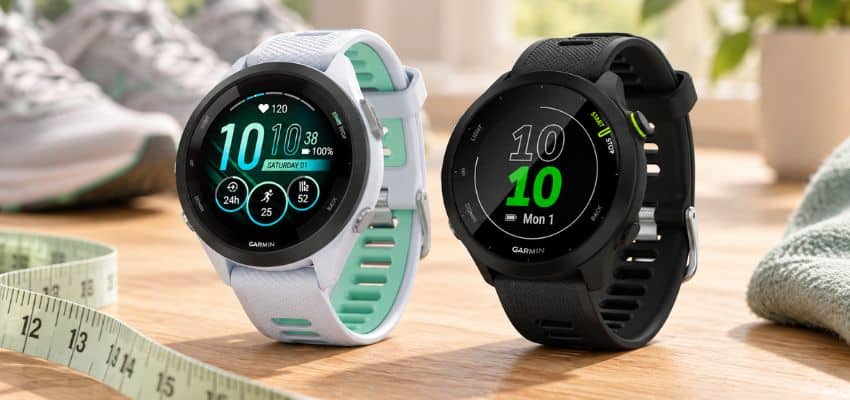
A running watch should stay where you put it, without asking your wrist to endure a tighter strap.
A watch can look pleasantly small in a product photo and still slide toward your hand before the first mile. Then comes the familiar bargain: one strap hole is loose, the next is uncomfortable, and you spend part of the run pushing the case back into place.
Choosing a running watch for small wrists starts with that problem. The useful measurements are the size of the case, how it rests across your wrist, and the range of the particular band you are buying. A watch described as lightweight or compact may still come with a strap that is too long.
I would shortlist the watches below by wrist measurement first, then compare the running features. There is no universal winner here. The Forerunner 265S has a notably shorter listed fit range; the COROS PACE 3 offers an adjustable nylon option; the smaller Apple Watch suits someone who also wants an everyday iPhone companion. None earns a promise that it will stay put on every wrist.
Before choosing
Shortlist by the problem you need to solve



Compare the fit before the features
A strap range is a useful first filter, not a comfort certificate. Two people with the same wrist circumference can have different wrist shapes. The table helps rule out an unsuitable configuration before you start comparing screens, training plans, or battery claims.
| Case dimensions | Published weight | Wrist / band range | ||
|---|---|---|---|---|
|
Garmin Forerunner 265S
Shorter stock strap
|
41.7 × 41.7 × 12.9 mm | 39 g | 115–178 mm stock strap | View options |
|
COROS PACE 3 with nylon band
Adjustable nylon fit
|
11.7 mm thick; check full case span | 30 g | Short 130–195 mm; standard 145–220 mm | View options |
|
Garmin Forerunner 55
Simple button controls
|
42 × 42 × 11.6 mm | 37 g | 126–203 mm stock strap | View options |
|
Garmin Forerunner 165
Larger AMOLED display
|
43 × 43 × 11.6 mm | 39 g | 126–203 mm stock strap | View options |
|
Apple Watch SE 3 GPS 40mm
For iPhone users
|
40 × 34 × 10.7 mm | 26.3 g | Apple lists 130–200 mm; verify selected band | View options |
The most important difference is near the bottom of those ranges. At a 120 mm wrist circumference, the stock Forerunner 55 and 165 straps fall outside their published fit range.
The 265S is within its stated range. That makes it a more sensible model to try first, even though its extra training features may be unnecessary for your runs.
A 40 mm Apple Watch is also not directly comparable with a 40 mm round watch. Apple measures case height; its smaller SE 3 is 34 mm wide.
With any shape, look at how the case and attachment points rest on your actual wrist. I would rather have a slightly wider case that lies comfortably than a smaller one held awkwardly above the skin.
Five running watches worth comparing for a smaller wrist
When the stock strap needs to fit a very small wrist: Forerunner 265S

When ordinary straps will not tighten enough, the Forerunner 265S offers a shorter listed wrist range; check that the smaller case sits flat.
The clearest reason to include the 265S is its published 115–178 mm wrist range. That lower limit is more useful for a very small wrist than simply calling a watch compact.
Its case measures 41.7 × 41.7 × 12.9 mm, and Garmin lists a weight of 39 g. The watch is not dramatically lighter than the Forerunner 165; the shorter fit range is the distinction that matters here.
It also gives you an AMOLED display, physical buttons and multi-band GPS. Those features make it a running-focused option, but they do not make it the necessary choice for someone timing easy run/walk outings.
I would consider it when the shorter stock strap solves a genuine fit problem and the purchase still fits the budget.
- Stock wrist range reaches lower than the 55 and 165.
- Buttons offer an alternative to touchscreen operation.
- Extra training tools may be unnecessary.
- You still need to try the case shape.
Choose the 265S, not a listing that switches to the larger 265 when you change color. Before ordering, compare the exact model with Garmin’s 265S specifications. During a try-on, check that the case does not rock from side to side and that the strap has enough room for comfortable adjustment.
When two strap holes are both wrong: COROS PACE 3 with nylon
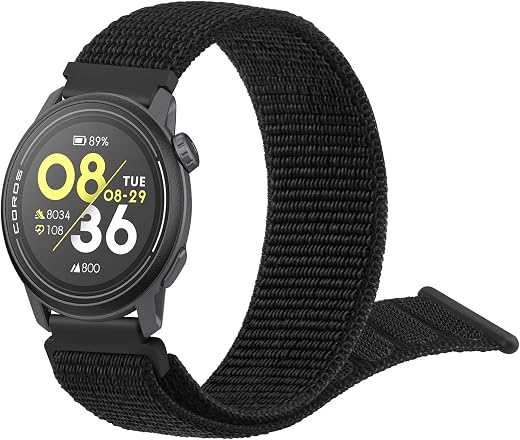
When strap holes leave you between sizes, the PACE 3 with nylon offers finer adjustment; confirm the exact band length before ordering.
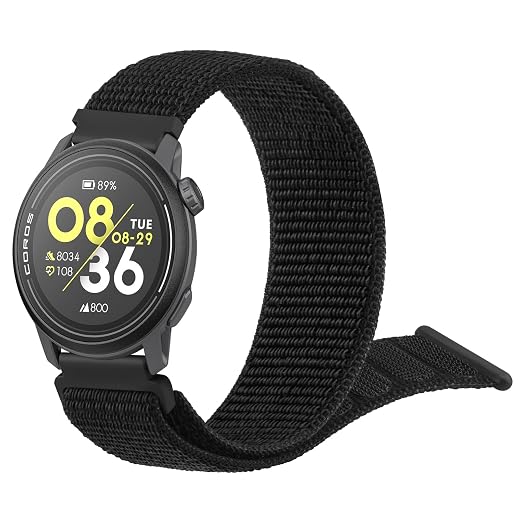
One silicone hole can leave a watch moving around; the next can feel like too much. A nylon closure lets you choose a position between those fixed steps. That is the practical reason to consider this configuration, rather than assuming a light watch automatically fits a narrow wrist.
COROS lists the PACE 3 at 30 g with its nylon band and 11.7 mm thick. It has built-in GPS and an always-on transflective display.
The low published weight makes it worth considering when the sensation of a heavy case is part of the problem. It does not establish that the included band will tighten enough.
- Nylon adjusts between fixed silicone-hole positions.
- The published 30 g weight refers to the nylon configuration.
- Short and standard replacement bands have different fit ranges.
- The retailer may include a different band.
Band versions need special care. The current COROS nylon-band listing gives 130–195 mm for the short version and 145–220 mm for the standard version; both are listed as compatible with PACE 3.
Older PACE 3 band listings show different ranges. Confirm the band in the actual package, not merely the watch name or a picture of a nylon strap.
For a wrist below 130 mm, I would not buy this setup on the assumption that the closure can simply be pulled farther. Ask for a verified smaller compatible option or try another watch.
Also think about band care: a fabric strap needs washing and drying after sweaty outings. Someone who prefers a quick wipe-down may favor silicone, provided its adjustment holes work.
When straightforward GPS and buttons are enough: Forerunner 55

For easy runs with simple controls, the Forerunner 55 keeps GPS tracking straightforward; its stock strap starts at 126 mm, not smaller.
The Forerunner 55 makes sense when your runs need a clear start button, elapsed time, pace and distance, rather than a long menu of advanced analysis. Garmin lists a 42 × 42 × 11.6 mm case, 37 g weight and 126–203 mm wrist range. It is a little lighter than the 165, but its strap does not start at a smaller wrist size.
Its memory-in-pixel screen and button controls are a different experience from a touchscreen smartwatch.
I would compare the actual run screen before buying: choose the numbers you use most, then check whether you can read them at a quick glance. A small case is less appealing if you must slow down and squint at every pace check.
- Physical buttons keep starting and stopping a run straightforward.
- Basic GPS tracking suits ordinary easy outings.
- Stock strap is not listed below 126 mm.
- Try the smaller display before ordering.
Garmin rates battery life at up to two weeks in smartwatch mode and 20 hours in GPS mode. These are separate usage claims, not a promise of two weeks while continuously tracking runs.
The Forerunner 55 specification sheet also identifies its 20 mm quick-release band fitting. A replacement band still needs the correct connector and a verified usable length.
For a wrist comfortably inside the range, this is a sensible basic option to try. For a wrist below 126 mm, it needs a different verified strap.
If budget is the main deciding factor, the lower-cost GPS options deserve comparison after you have ruled out models that cannot fit.
When readability matters as much as a compact case: Forerunner 165

When tiny numbers are hard to read, the Forerunner 165 offers a larger AMOLED display; its 43 mm case still needs a fit check.
The 165 earns its place as a readability trade-off. Garmin lists a 1.2-inch AMOLED display, compared with the 55’s 1.04-inch display. If small numbers are already frustrating, a slightly larger display may be worth trying before deciding that the narrowest case is always preferable.
The compromise is a 43 × 43 × 11.6 mm case and a 39 g published weight. Its stock 126–203 mm wrist range is the same as the Forerunner 55’s. I would not present this as the default answer for a very small wrist.
It belongs on the shortlist when the case rests comfortably and the extra screen space solves a real viewing problem.
- More display space can make run data easier to glance at.
- Touch and button controls offer two ways to operate it.
- Stock strap shares the 55’s lower fit limit.
- The wider case needs a wrist-bend check.
It offers buttons as well as touch controls, with built-in GPS. Garmin lists up to 11 days in smartwatch mode and 19 hours in GPS-only mode.
Those claims vary with settings and use. The Forerunner 165 specifications are a useful reference when a retailer mixes information from the standard and Music versions.
During a try-on, bend your wrist as you would while opening a door or reaching into a pocket. The case should not press into the back of your hand.
Then open a simple running screen and read it without bringing it close to your face. This choice only makes sense when both the fit and visibility improve your ordinary outing.
When one watch needs to cover runs and iPhone life: Apple Watch SE 3 40mm

For runs and everyday iPhone use, the 40 mm SE 3 offers a narrow rectangular case; choose the band size separately and carefully.
For an iPhone user who wants a watch for everyday tasks as well as running, the smaller SE 3 is a different kind of choice. Apple lists a 40 × 34 × 10.7 mm case, weighing 26.3 g for the GPS version before adding a band.
That case-only number should not be compared as though it includes the same components as the Garmin or nylon-equipped COROS weights.
Apple lists a 130–200 mm wrist range for the smaller case, but the band you choose still needs its own size check. A finely adjustable loop is worth trying if fixed holes have caused trouble. Do not assume that every 40 mm retailer package includes the same band or band length.
- Useful when daily smartwatch functions already matter.
- A narrow rectangular case offers another shape to try.
- Band choice remains part of the fit decision.
- Frequent charging may not suit your routine.
The SE 3 has built-in GPS and running workout tracking, but its charging routine differs from a dedicated running watch. Apple states up to 18 hours of normal use; that is not 18 hours of GPS workout recording.
Check Apple’s SE 3 specifications for current battery and iPhone compatibility requirements before choosing a package.
I would favor this route if the everyday smartwatch functions already matter to you. Someone who mainly wants running buttons and fewer charging interruptions may prefer a dedicated model.
The distinction between smartwatches and running watches can settle that decision without treating either category as automatically better.
A smaller band may be enough to keep your current watch
Before replacing a working watch, separate two problems: a band that is too long and a case that is too large. A compatible shorter band can address the first. It cannot shrink the case or move attachment points that extend awkwardly beyond your wrist.
-
The case rests well, but the band stays loose
Look for a compatible shorter band with a published fit range that includes your wrist. A continuously adjustable closure is worth trying when fixed holes fall between comfortable settings.
Look forCorrect connector and verified lengthAvoidBuying by band width alone -
The case rocks or presses into your hand
Try a different case shape or smaller full span. Tightening the existing band harder may hold the watch down, but it does not create a comfortable fit.
Look forA case that lies comfortably across the wristAvoidUsing pressure to compensate for overhang -
The fit works, but the controls or numbers do not
Check the running screen and controls before changing size. The smallest watch is not useful if its display makes every pace check a struggle.
Look forReadable data and manageable controlsAvoidChoosing solely by case diameter
Band width is the connector measurement, not the wrist-size range. An 18 mm or 22 mm band can still be too long. Check the attachment system, compatibility with the exact watch, shortest wearable circumference and any bulky folded section near the case. A product photo rarely answers all four questions.
I would also resist paying for features simply because they arrive in a small case. A first running watch only needs to make the runs you are doing easier to manage.
If elapsed time is all you need, a basic sports timer may be enough; it should not be mistaken for a GPS or wrist-heart-rate device.
Check the fit while moving, before committing to the watch
A comfortable desk fit is only the first check. Use a try-on or a retailer-approved trial to find out what happens when your arm moves. Check return conditions first: wearing a watch outside may affect whether it can be returned.
-
Measure the wearing position
Wrap a flexible tape around the wrist where the case will sit, above the wrist bone. Keep the tape against the skin without pulling it tight. Record the measurement in millimeters.
-
Match the exact band
Compare that number with the selected band’s fit range. Verify the model, case size, band material and band length in the order details; color changes can switch the configuration.
-
Set a comfortable closure
The case should rest against your skin without pinching. Check for a stiff folded strap, excess tail that cannot be secured, or a case edge pressing into your hand.
-
Move before judging
Swing your arms, bend your wrist and use the controls. If the watch shifts, make one small adjustment. When stability requires uncomfortable pressure, reconsider the band or case.
-
Recheck after a permitted easy outing
Notice repeated sliding, rubbing or pressure once you start moving. Loosen or remove the watch if it hurts or irritates your skin; do not keep tightening it to force the fit.
Manufacturer instructions take priority over an arbitrary number of fingers or centimeters. Garmin’s wearing advice calls for a position above the wrist bone that is snug but comfortable and does not shift during exercise. The aim is steady contact, not a strap pulled to its limit.
Fit and measurement accuracy remain separate decisions. If a sensor gives odd numbers after the watch sits comfortably, the heart-rate fit checks cover the next steps.
If the recorded route wanders, GPS route troubleshooting addresses a different problem; a tighter strap is not a general cure for a poor route trace.
Recording a GPS run without a phone does not mean every safety feature works without one. The requirements for emergency contact features depend on the model, connection and setup. Check those separately if contacting someone during a run is part of your buying decision.
Choose the fit that needs the least negotiation
For a very small wrist, I would start with the Forerunner 265S because its listed stock range reaches lower. For a wrist inside the relevant nylon-band range, the PACE 3 is worth comparing when fixed strap holes are the irritation.
The 55 offers straightforward GPS controls; the 165 trades a little case size for display space. The 40 mm SE 3 makes sense when an iPhone smartwatch is useful beyond the run.
The best running watch for small wrists is the one whose exact case and band work together on your wrist. Keep the choice simple: measure, rule out unsuitable bands, try the remaining shapes, then pay for the features you actually need.
If your current watch works with a shorter compatible band, that is a perfectly good result. You do not owe yourself a new watch just because the old strap was the wrong length.