
A marker should define the drill, not become the next obstacle.
The best running drill cones for a garage strip, patio corner, hallway, or small patch of grass are usually low, flexible, easy to see, and quick to remove. They do not correct posture or make a drill more effective by themselves. Their modest job is to show where a lane begins, where a turn happens, or how far one short pass should travel.
That job changes with the space. Flat discs keep the trip profile low on smooth indoor floors. Shallow dome cones are easier to see and often suit mixed indoor-outdoor use. Small upright cones remain visible in grass but occupy more physical and mental space. Choosing the best cones for running drills therefore starts with the lane and surface – not with the largest bundle or the shape that looks most professional.
- Stands out against the floor or ground
- Stays low and gives when accidentally stepped on
- Stores as one compact stack instead of becoming household clutter
Three marker sets with different strengths


Choose running drill cones for the lane
-
The unobstructed practice strip
A spare bedroom can look generous until a chair, rug edge, open door, and turning body take their share. Measure the clear length and narrowest usable width while the room is arranged normally. A 10-foot strip may support marching, quiet steps, and one small gate; a gap beside furniture needs markers that flex or slide aside.
Useful inA clear route with room to turn, slow down, and step around the layoutPoor fit whenFurniture edges, doors, stairs, traffic, another person’s route, or an escape path narrowed by cones -
Flat marker discs
A broad, almost flush disc creates the smallest obstacle and suits foot-placement lanes where a shoe may cross the marker. It can also mark start and finish points without making the room feel crowded. Visibility is the compromise: a thin disc may disappear against grass, patterned flooring, or deep carpet.
Useful inSmooth indoor floors, short gates, and places where accidental steps are likelyPoor fit whenThe surface hides the colour or lifts the edge -
Low-profile dome cones
A shallow dome is easier to read from several metres away while remaining much less intrusive than an upright field cone. Flexible domes stack neatly and work well as turning points. For many beginners, they are the most adaptable agility cones for runners moving between a patio, garage, and park.
Useful inMixed surfaces, visible endpoints, and a compact stack for storagePoor fit whenHard plastic or a base that slides on the intended floor -
Small upright cones
An upright cone gives the clearest boundary in grass or a larger outdoor lane. Height becomes a disadvantage indoors, beside walls, or anywhere the foot must pass close to the marker. A clipped cone interrupts the drill and can turn a harmless mistake into a stubbed toe.
Useful inOutdoor visibility with generous clearance around every markerPoor fit whenConfined lanes, lateral footwork, rigid material, or narrow bases
Judge the missed step, not the perfect pass
A marker is easiest to admire when nobody touches it. The more useful question is what it does when a beginner lands partly on the edge, brushes it while turning, or forgets the layout for half a second. Soft discs and flexible domes tend to bend or shift. Tall rigid cones remain something the body must clear. In a short lane, forgiving contact matters more than a professional silhouette.
Remember where the set lives afterward
Small spaces often serve several jobs. The practice lane may need to become a hallway, garage bay, or family room again within minutes, so small space training cones should stack, travel together, and fit into a drawer or gear bin. A set that is easy to put away is also less likely to remain underfoot. Safe preparation begins with an uncluttered path; the older overview of starting to run without getting injured places sensible surroundings and gradual effort ahead of any accessory.
Place the markers, walk the full pattern in both directions, and lightly nudge each base. Remove any cone that slides, tips, hides against the surface, narrows the escape path, or sits close to furniture, traffic, stairs, or another person’s route through the space.

The Gamecraft pack includes 12 soft, flexible dome cones, approximately 3 inches high and 7¾ inches wide, in six colours. Their shallow shape is easier to see than a flat marker but less intrusive than a tall field cone, making them a balanced choice for compact lanes on carpet, rubber flooring, turf, pavement, or short grass.
Match running drill cones to the surface
Smooth indoor floors need the lowest interruption
Flat spot markers make sense when the route crosses the marker or passes close beside it. Their broad contact area and tiny height keep the lane visually simple. Still, PVC and plastic behave differently across polished wood, tile, and rubber flooring. Wipe away dust, place one marker, and test it with a gentle shoe brush before laying out the entire pattern. A product called non-slip can still move when the floor supplies very little friction.
Pavement favors a broad flexible base
On concrete or asphalt, flat discs and shallow domes tolerate an accidental step better than rigid upright cones. Domes remain easier to see at the far end of a driveway, while discs create quieter gates. Check cracks and joints before spacing anything. A cone that sits partly over a seam can rock or curl even when it behaves perfectly on an uninterrupted surface.
Grass asks for visibility before elegance
Closely cut, even grass can support bright domes or small upright cones, but thin discs often vanish among shadows and blades. On longer grass, slopes, divots, or wet ground, the real problem is the surface rather than the marker. Move to a clearer patch or simplify the drill. Lightweight agility cones for runners are reference points, not tiny anchors sent out to negotiate with weather and soil.
Choose a bright, shallow dome when one set must work on a garage mat, dry patio, and short grass. Choose flat discs instead when feet regularly cross the markers indoors. Upright cones earn their extra height only where outdoor visibility outweighs compactness.
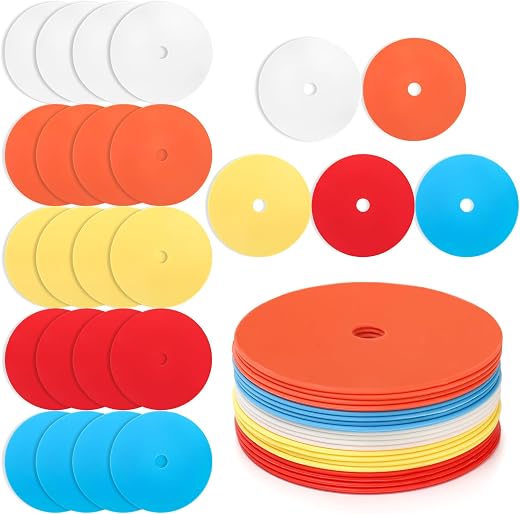
The Eorbow set provides 20 PVC spot markers in five colours. Each marker is about 6 inches wide and only 0.08 inch thick, so it creates a clear reference point without placing a raised obstacle beside the feet. This makes the set particularly useful on smooth indoor floors, studio spaces, hallways, and garage lanes.
Buy the quantity the lane can use
How many cones fit a short practice lane?
A handful of well-placed markers is more useful than a crowded bag. Begin with the number the current lane can use; another small set can be added later when a repeatable layout genuinely needs it.
Give every cone one clear job
- Mark the beginning and end. Place two cones along the clearest straight strip. Shorten the distance when the turn approaches a wall, parked car, furniture, another path user, or uneven ground.
- Add one or two gates. Use pairs of markers to show where a march, quiet-step drill, or gentle shuffle begins. Leave enough room to pass without steering the feet around the cones.
- Walk the whole pattern. Approach every turn and gate from both directions. Remove any marker that causes hesitation, disappears from view, or shifts when lightly brushed.
- Repeat before redesigning. Keep the same spacing for several sessions so the markers stop demanding attention. These five beginner running drills make better use of a few clear reference points than a floor covered with cones.
Cones can define distance, direction, or a boundary. They cannot correct posture, arm swing, foot strike, or cadence – and they should never make the route harder to leave safely.

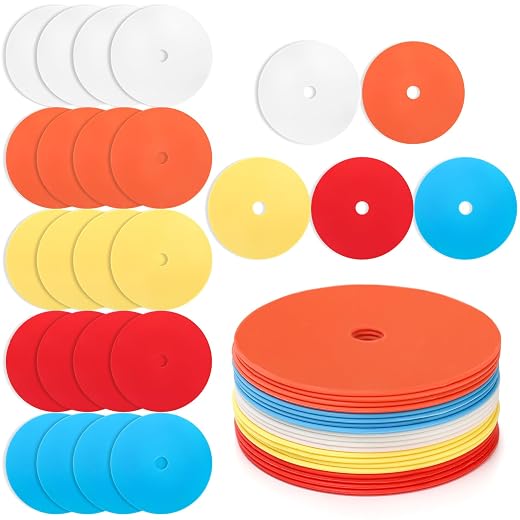
This FGBNM set contains 25 flexible disc cones in five colours, plus a holder and carry bag. The quantity suits runners who use several colour-coded gates, keep two small layouts ready, or share a practice space. The holder speeds up collection, while the bag keeps the set together in a garage or car
How the picks were checked
The comparison focused on products whose current listings supplied enough information to judge marker shape, dimensions, count, material, colour mix, and included storage. Prices were not used as fixed facts because offers and availability change.
-
The set had to remain compact
Low height, stackability, and a holder or bag mattered because the intended spaces must return to ordinary use. Team-sized bundles received no advantage merely for supplying more pieces.
-
The listing had to explain the marker
Dimensions, material, quantity, and included accessories were checked against the current product listing. Seller claims such as non-slip were treated as claims to test on the intended surface, not guarantees that apply to every floor.
-
Each recommendation needed a distinct job
The balanced pick had to combine visibility and a low flexible shape. The indoor pick had to keep the profile nearly flat. The value pick had to provide a useful 20–25-marker quantity with storage rather than win through a temporary price alone.
Product details, sellers, stock, and price can change. Check the current listing and return terms before buying, then test the markers at walking pace before using them for a drill.
Let the cones disappear into the drill
- Begin with one simple layout and change only one variable at a time.
- The lowest marker that stays visible is usually more useful than the tallest one available.
For most compact practice areas, the best cones for running drills are flexible domes when visibility matters and flat spot markers when feet may cross the boundary. Six cones can create a useful beginning; 10–12 usually gives one runner enough gates and spares; 20–25 suits someone who genuinely changes layouts.
Once the markers are visible, stable, and safely spaced, their job is finished. They provide reference points, not a running lesson. Keep the first pattern simple, then turn to beginner-friendly running form techniques for the movement the cones cannot teach.